
Heavy-Duty Rotary Airlocks | Built to Be Rebuilt
Wear is inevitable. Replacing the entire Rotary Airlock doesn’t have to be.
Most industrial Rotary Airlocks are treated as disposable bulk material handling components. PMM takes a different approach by engineering rebuildable rotary airlocks for long-term serviceability. With conventional airlocks, once critical components wear beyond acceptable operating tolerances, the entire unit must be removed from service and replaced with a brand-new airlock. Over time, many industrial facilities accumulate a boneyard of worn Rotary Airlocks that represent significant capital investment in equipment that could no longer be economically serviced.
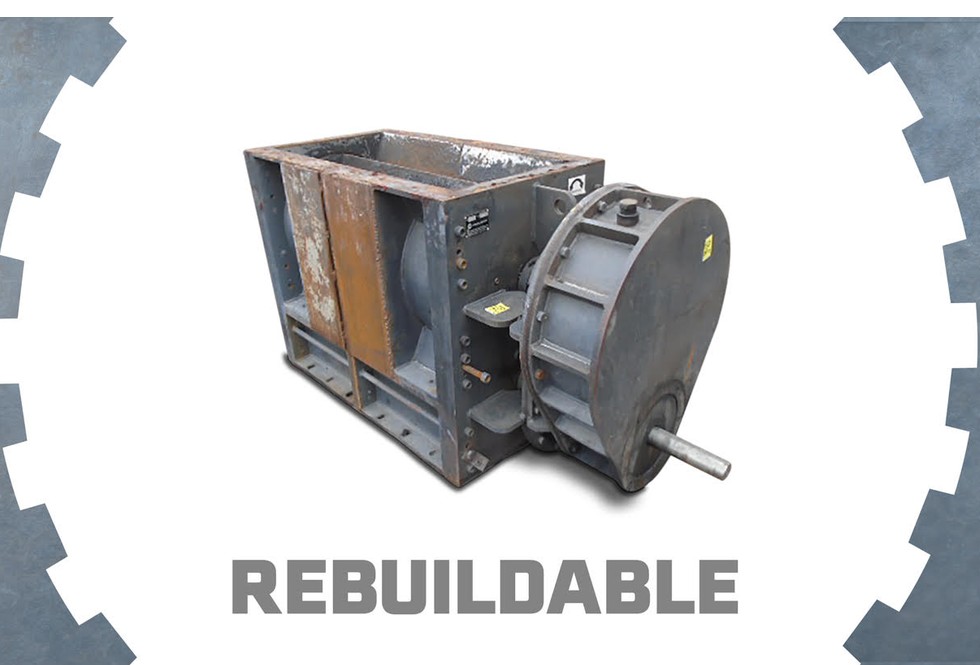
Precision Machine & Manufacturing takes a fundamentally different approach. PMM Rotary Airlocks are engineered from the beginning to be rebuilt. Rather than treating the entire unit as disposable when individual components wear, PMM equipment is designed so components can be evaluated, reworked or replaced as required to restore the Rotary Airlock to proper operating condition.
That rebuildability can significantly extend equipment service life while reducing capital expenditures over the lifecycle of the equipment. Depending on the PMM Rotary Airlock and the service required, maintenance may include field replacement of serviceable components or a complete factory rebuild at PMM’s Eugene, Oregon manufacturing facility.
The result is a Rotary Airlock engineered not simply for the application and material being conveyed, but with the knowledge that industrial equipment operating in demanding environments will eventually wear. PMM engineers its Rotary Airlocks in preparation for that wear and the operational challenges it creates.

Rebuild vs. Replace: The Lifecycle Advantage
PMM Rotary Airlocks are engineered around a fundamentally different lifecycle philosophy: when components wear, service the components that need attention rather than automatically replacing the entire unit. That approach provides both operational and financial advantages throughout the service life of the equipment.
Cost
Lower Lifecycle Cost
Rework or replace worn components rather than automatically purchasing an entirely new Rotary Airlock, reducing capital expenditures over the lifecycle of the equipment.
Uptime
Planned Maintenance
Rebuildability gives maintenance teams the ability to inspect wear, service applicable components and plan rebuilds before equipment condition results in an unexpected failure or unplanned shutdown.
Rebuild
Factory Rebuildability
Every PMM Rotary Airlock can be returned to PMM for complete disassembly and evaluation against its original factory specifications. Components are reworked or replaced as required, with bearings, seals and packing always replaced, and the rebuilt unit returned with a new factory warranty.
Engineering
Engineered for the Application
PMM Rotary Airlocks are engineered for the material, operating environment and application rather than selected as a one-size-fits-all component. That same engineering philosophy extends to how the equipment is maintained, serviced and ultimately rebuilt.
Engineered to Be Rebuilt
PMM Rotary Airlocks are engineered for long service life and designed to be rebuilt when wear eventually requires individual components to be serviced, reworked or replaced. Rather than treating the entire Rotary Airlock as disposable, PMM designs its equipment with rebuildability and long-term serviceability in mind.
Factory Rebuild: PMM completely disassembles every Rotary Airlock and evaluates each individual component against its original factory specifications. Based on that evaluation, each component is either reworked to restore it to original factory specifications or replaced entirely, with bearings, seals and packing always replaced. This top-to-bottom rebuild process restores the Rotary Airlock to the required operating condition and returns it to the customer with a new factory warranty.
Field Serviceability: PMM’s Rotary Valve Airlock features a unique modular design that allows the complete unit to be broken down into individual subassemblies, enabling worn components to be serviced or replaced in the field. The most commonly serviced wear components are the barrel sides and wear plates.
PMM’s Rotary Airlock Feeder has more limited field serviceability. Packing and bearings can be serviced in the field; however, PMM recommends returning Rotary Airlock Feeders to our Eugene, Oregon facility for a complete factory rebuild.
The rebuildability of PMM’s Rotary Airlocks, whether through field service of applicable components or a complete factory rebuild, can significantly reduce capital expenditures over the lifecycle of the equipment by eliminating the need to replace the entire unit simply because individual components have worn.
Built for Industry’s Toughest Materials
Chemical Processing | Texas
Customer reported $60,000 in annual maintenance-cost savings.
Challenge, PMM Solution and Documented Result
Customer-Reported Results | Chemical Processing Facility | Texas | 2003
- Challenge
- The customer’s existing rotary valve required frequent maintenance and removal from service to replace nylon wear pads. Performance degraded quickly, with the previous valve operating for a maximum of approximately two months before the pads required replacement.
- PMM Solution
- A PMM PMV-8 Rotary Valve Airlock provided easier maintenance, more predictable leakage and improved process stability. Its modular construction also allowed wear surfaces to be serviced without removing and replacing the entire valve.
- Documented Result
- The customer reported $60,000 in annual maintenance-cost savings, reduced product loss, and five months of operation with no signs of wear at the time of the testimonial. The customer also reported an 85% reduction in capital cost for future rotary-valve installations, noting that the previous valve cost approximately 12 times as much as the PMV-8 and required a larger footprint and greater utility consumption.
Cement Manufacturing | Kansas
Two years of operation with zero maintenance, no loss in throughput or efficiency, and no unscheduled downtime.
Challenge, PMM Solution and Documented Result
- Challenge
- Competitive rotary airlocks operating in highly abrasive applications experienced rapid wear, material leakage and declining airlock functionality. Some competitive units lasted only 6–8 months at best, resulting in frequent maintenance and premature equipment replacement.
- PMM Solution
- The plant began replacing cast-iron rotary airlocks with PMM Rotary Valve Airlocks engineered with abrasion-resistant construction and a modular design that allows worn components to be serviced or replaced rather than requiring replacement of the entire valve.
- Documented Result
- In a direct application comparison, a PMM Rotary Valve Airlock operated for two years with zero maintenance, no loss in throughput or efficiency, and no unscheduled downtime. The customer reported that PMM Rotary Valve Airlocks outlasted the cast-iron airlocks by more than 2-to-1, while their rebuildable design reduced the plant’s capital expenditure by allowing worn components to be replaced during scheduled outages rather than replacing the entire Rotary Airlock.
Customer Quote:
“Precision’s Rotary Valve MADE my plant what it is today!”
Wood Products | Washington
Four years and counting with zero maintenance, while maintaining required airlock functionality.
Challenge, PMM Solution and Documented Result
4+ Years | Zero Maintenance | Airlock Functionality Maintained
- Challenge
- The facility was operating multiple Double Dump Valve systems that required frequent maintenance and experienced material leakage and reduced performance. Moisture contributed to corrosion, while material buildup interfered with proper door operation and sealing.
- PMM Solution
- The Double Dump Valve system was replaced with a PMM Rotary Valve Airlock engineered for the material and operating environment. The simpler rotary design eliminated the multiple doors, channels and sealing points that had contributed to the customer’s maintenance problems.
- Documented Result
- The PMM Rotary Valve Airlock has now operated for four years and counting with zero maintenance required, while maintaining the airlock functionality required by the application.
Biomass Power | South Central & Southeast U.S.
Substantially less wear at both facilities; South Central facility fully converted to PMM. Southeast customer projects at least three years of service life, with potential to approach four years.
Challenge, PMM Solution and Documented Result
- Challenge
- Two biomass power facilities conveying wood waste had historically relied on European-manufactured Rotary Airlocks. The plants typically achieved approximately 1½ to 2 years of service life from the imported equipment while also dealing with long lead times, tariffs and limited practical access to rebuild services.
- PMM Solution
At the South Central facility, a PMM Rotary Airlock Feeder was installed and closely evaluated against the plant’s existing equipment. The plant observed a noticeably tighter seal from the PMM Rotary Airlock Feeder, providing greater airlock functionality while also seeing significantly less wear over time.
Based on the success of that installation, a second biomass power facility in the Southeast conducted its own comparison, evaluating a PMM Rotary Airlock Feeder alongside a brand-new competitive Rotary Airlock.
- Documented Result
At both facilities, the PMM Rotary Airlock Feeders demonstrated substantially less wear than the competitive Rotary Airlocks operating in the respective facilities.
The South Central facility has already converted completely to PMM Rotary Airlock Feeders based on the results of its evaluation.
At the Southeast facility, after approximately 1½ years of operation, the brand-new competitive Rotary Airlock was approaching replacement while the PMM Rotary Airlock Feeder showed very little wear. Based on the observed wear rate, the customer projects at least three years of service life, with the potential to approach four years, which would be approximately twice the historical service life of the equipment being replaced.
The Southeast facility has approved moving forward with replacing the remaining three competitive Rotary Airlocks with PMM Rotary Airlocks during its next scheduled outage and plans to utilize PMM’s rebuild program as part of its long-term maintenance strategy.
Rebuildable Rotary Airlocks by Industry
PMM Rotary Airlocks operate across a wide range of industrial applications, materials and operating environments. The examples below represent a sampling of actual PMM applications and demonstrate the range of materials, temperatures, throughput requirements and operating conditions PMM has encountered over nearly five decades of bulk material handling experience.
These examples are provided as application references only. Equipment selection, materials of construction, clearances and operating configuration are engineered for the requirements of each individual application.
Cement Manufacturing
| Material | Temperature | Throughput |
|---|---|---|
| Raw mill limestone clinker | 241°F | 400 MTPH |
| Limestone | 200°F | 9 STPH |
| Lime dust | 230°F | 831.6 ft³/hr |
| 1″ clay stone | 200°F | 5 MTPH |
| Pebble lime | 200°F | 15–20 STPH |
| Lime kiln dust | 250°F | 140 TPH |
| Kiln dust | 375°F | 40 TPH |
| Ground cement | 180°F | 200 MTPH |
| Concrete mix | Ambient | 36,000 lbs/hr |
| Clinker dust | 700°F | 2 STPH |
| High-calcium lime powder | 300°F | 30 STPH |
| Cement kiln dust | 400°F | 10 STPH |
| Cement meal | 810°F | 200 MTPH |
| Cement dust | 212°F | 1,200 lbs/hr |
| Kiln feed cement dust | 572°F | 86 STPH |
Coal-Fired Power & Cogeneration
| Material | Temperature | Throughput |
|---|---|---|
| Pulverized coal | 200°F | 15 STPH |
| Lime & pet coke | 300°F | — |
| Lignite coal | 250°F | 65,000 lbs/hr |
| Lignite coal | 300°F | 50 STPH |
| Subbituminous coal fines | 213°F | 27,500 lbs/hr |
| Coal dust | Ambient | 35 TPH |
| Coal & pet coke | 176°F | 6 MTPH |
| Coal / pet coke mix | 170°F | 8 TPH |
| Bituminous coal | 175°F | 1,000 MTPH |
| Pulverized coal | Ambient | 25 tons/hr |
| Lignite coal | Ambient | 40 TPH |
— = not specified in the application reference.
Biomass Power
| Material | Temperature | Throughput |
|---|---|---|
| Green wood chips | 250°F | 255,750 lbs/hr |
| Sodium sulphate | 86°F | 5–6.25 MTPH |
| Wood pellets | 250°F | 278,000 lbs/hr |
| Oak & pine wood pellets | 175°F | 7,000 lbs/hr |
| Hazardous waste solids | Ambient | 6 STPH |
| Green wood chips | 350°F | 110 STPH |
| Fly ash | 200°F | 95,000 lbs/hr |
| Dried bio-solids | Ambient | 12 MTPH |
| Biomass mixture | Ambient | 211,851 lbs/hr |
Wood Products
| Material | Temperature | Throughput |
|---|---|---|
| Southern yellow pine planer shavings | Ambient | 12 MTPH |
| Wood chips | Ambient | 12,000 lbs/hr |
| Wood waste | Ambient | 6,000 lbs/hr |
| Veneer chips | Ambient | 5,000 lbs/hr |
| Wood chips | 100°F | 16 MTPH |
| Pine, hemlock and fir sawdust | Ambient | 3,000 lbs/hr |
| Kiln-dried hardwood / hogged flooring | Ambient | 22.5 TPH |
| Fly ash | 1,500°F | 200 lbs/hr |
| Bottom ash | 350°–600°F | — |
| Alder hardwood chips | Ambient | 19.5 STPH |
— = not specified in the application reference.
Pulp & Paper
| Material | Temperature | Throughput |
|---|---|---|
| 2″ cellulose pulp | Ambient | 2 MTPH |
| Pulp chips & sawdust | Ambient | 25 MTPH |
| Precipitator wood fly ash | 350°F | 94 CFH |
| Paper pulp | Ambient | 100,000 lbs/hr |
| Cellulose pulp | Ambient | 2.0 MTPH |
Plastics & Chemicals
| Material | Temperature | Throughput |
|---|---|---|
| UMVW / UHMW scraps | Ambient | 360 lbs/hr |
| Toluene Diisocyanate (TDI) | Ambient | — |
| Polypropylene flakes | Ambient | 12,700 lbs/hr |
| Plastic pellets | Ambient | 40,000 lbs/hr |
| Plastic flake | Ambient | 20,000 lbs/hr |
| HDPE plastic pellets | 120°F | 2,000 lbs/hr |
| HDPE natural, HDPE color, PET and mixed plastic pellets | Ambient | 1.5 TPH |
| Sodium sulphate | 86°F | 6.25 MTPH |
— = not specified in the application reference.
Metals & Minerals
| Material | Temperature | Throughput |
|---|---|---|
| Lime dust | 480°F | 2.5 MTPH |
| Gypsum powder | 200°F | — |
| Gold ore | Ambient | 6,251 lbs/hr |
| Sand mixture | 105°F | 2,000 lbs/hr |
| Pet coke | Ambient | 50,000 lbs/hr |
| Limestone powder | Ambient | 7.2 STPH |
| Land plaster | 140°F | 40 TPH |
| High-calcium lime powder | 300°F | 30 STPH |
| Calcium carbonate powder | 140°F | 25 TPH |
| Graybond | Ambient | 30 TPH |
| Diatomaceous earth | Ambient | 2,700 lbs/hr |
| Trona | Ambient | 10,000 lbs/hr |
— = not specified in the application reference.
Food & Agriculture
| Material | Temperature | Throughput |
|---|---|---|
| Dry chili pods (stainless steel Rotary Airlock) | Ambient | 2,210 lbs/hr |
| Frozen water droplets (9 lbs/ft³) | -40°C | — |
| Grain dust | Ambient | — |
— = not specified in the application reference.
Alternative Fuels & Dust Collection
| Material | Temperature | Throughput |
|---|---|---|
| Rubber tires & wood waste | Ambient | 5 MTPH |
| Peanut husks | Ambient | 29 MTPH |
| Hog fuel (shredded tires, wood waste, recycled pallets, sawdust) | Ambient | 35 STPH |
| Fine dust collection | Ambient | 100 TPH |
| Baghouse dust | 250°F | 11 STPH |
| Recycled materials | 212°F | 6.5 MTPH |
| Alternative fuels | Ambient | 10 TPH |
| Rubber tire chips | Ambient | 20 STPH |
| Bituminous fine coal | Ambient | 120 lbs/hr |
Biocarbon & Charcoal
| Material | Temperature | Throughput |
|---|---|---|
| Biocarbon | 140°F | 0.8 TPH |
| Activated carbon | 350°F | 800 lbs/hr |
| Activated carbon | 120°F | 30 STPH |
| Activated carbon | 100°F | 200–800 lbs/hr |
| Biocarbon | 140°F | up to 0.8 TPH |
| Hog fuel | Ambient | 3 STPH |
Frequently Asked Questions
What is the difference between a Rotary Airlock, Rotary Valve Airlock and Rotary Airlock Feeder?
Rotary Airlock is a broad industry term commonly used to describe industrial bulk material handling equipment that utilizes a rotating-vane device to meter or seal bulk material flow while helping maintain separation between different pressure environments. At PMM, Rotary Valve Airlocks and Rotary Airlock Feeders are distinct product designs engineered for different application requirements.
PMM Rotary Valve Airlocks are constructed from highly durable, abrasion-resistant materials and feature a highly modular design that allows the unit to be broken down into individual subassemblies so applicable wear components can be serviced or replaced in the field. PMM Rotary Valve Airlocks are engineered for a broad range of bulk material handling applications, including high- and low-flow conditions, high-temperature environments, and abrasive, wet, sticky and cohesive materials in powder or granular form.
PMM Rotary Airlock Feeders are also constructed from robust, abrasion-resistant materials and are designed for applications involving oversized, fibrous or stringy materials. They incorporate a helical rotor operating against a hardened tool-steel knife to cut material that could otherwise become trapped between the rotor and housing. PMM Rotary Airlock Feeders are completely rebuildable when returned to PMM’s manufacturing facility in Eugene, Oregon.
How much can a rebuildable Rotary Airlock save?
The lifecycle savings associated with a rebuildable Rotary Airlock vary by application, operating conditions, maintenance requirements and the extent of the rebuild required. Generally costing approximately 50–75% of the price of a new PMM Rotary Airlock, rebuilding can provide substantial savings compared with purchasing new equipment. When that ability to rebuild and reuse the equipment is extended across multiple service cycles, the cumulative savings over the lifecycle of the Rotary Airlock can become significant.
The economic advantage extends beyond the cost of the rebuild itself. When individual components wear, PMM Rotary Airlocks can be serviced, reworked or rebuilt rather than automatically requiring replacement of the entire unit. This can reduce capital expenditures, maintenance costs and the costs associated with equipment removal, replacement and unplanned downtime.
In one documented chemical-processing application at a Texas facility, the customer reported that a PMM PMV-8 reduced maintenance costs by $60,000 per year while also reducing product loss. The customer also reported that its previous rotary valve cost 12 times as much as the PMV-8 and that using PMM equipment reduced the capital cost of future rotary-valve installations by 85%, due in part to lower equipment cost, a smaller footprint and reduced utility requirements.
Actual rebuild costs and lifecycle savings are application-specific and depend on equipment condition, the components requiring rework or replacement, operating environment and maintenance requirements.
Does a rebuilt PMM Rotary Airlock come with a warranty?
Yes. Every PMM Rotary Airlock that completes a factory rebuild at PMM’s Eugene, Oregon manufacturing facility is returned with a new factory warranty.
During the rebuild, the Rotary Airlock is completely disassembled and each individual component is evaluated against its original factory specifications. Components are reworked to restore them to original factory specifications or replaced entirely as required, with bearings, seals and packing always replaced. Once the rebuild is complete, the Rotary Airlock is returned to the customer with a new factory warranty.
How often does a PMM Rotary Airlock need to be rebuilt?
There is no predetermined rebuild interval for a PMM Rotary Airlock. Wear rates vary based on the material being conveyed, throughput, operating hours, temperature, pressure differential, moisture, abrasiveness, internal clearances and other application-specific operating conditions.
PMM recommends monitoring equipment condition and wear rather than relying solely on a calendar-based rebuild schedule. Because PMM Rotary Airlocks are rebuildable, worn components or a complete Rotary Airlock rebuild can be addressed as required and scheduled around a planned outage, rather than waiting for deterioration to progress to the point of critical failure, resulting in unplanned downtime and potentially requiring replacement of the entire unit.
The objective is to address wear before it begins creating broader operational problems such as increased blow-by, reduced airlock functionality, diminished throughput or unplanned downtime.
Can wear on PMM Rotary Airlocks be addressed in the field?
Yes, depending on the PMM Rotary Airlock design, the component experiencing wear and the extent of service required.
PMM Rotary Valve Airlocks feature a highly modular design that allows the complete unit to be broken down into individual subassemblies. Applicable worn components can be serviced or replaced in the field, with barrel sides and wear plates among the most commonly serviced wear components.
PMM Rotary Airlock Feeders have more limited field serviceability. Packing and bearings can be serviced in the field; however, PMM recommends returning Rotary Airlock Feeders to its Eugene, Oregon manufacturing facility when more extensive wear requires a complete rebuild.
When a complete factory rebuild is required, PMM completely disassembles the Rotary Airlock and evaluates every individual component against its original factory specifications. Components are reworked to restore them to original factory specifications or replaced entirely as required, with bearings, seals and packing always replaced. The rebuilt Rotary Airlock is then returned to the customer with a new factory warranty.
Ready to Extend the Life of Your Rotary Airlock?
Whether you’re evaluating wear on an existing PMM Rotary Airlock, considering a factory rebuild, or looking to replace equipment that has become a recurring maintenance problem, PMM can help evaluate the application and determine the appropriate next step.
PMM is built for the hard stuff.